
1704 products
Sort by:
1704 products
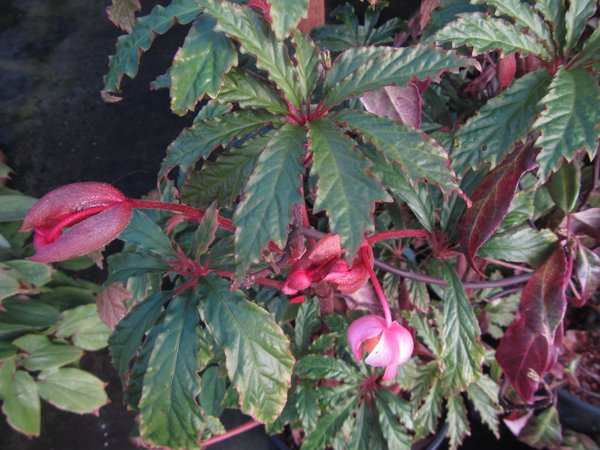
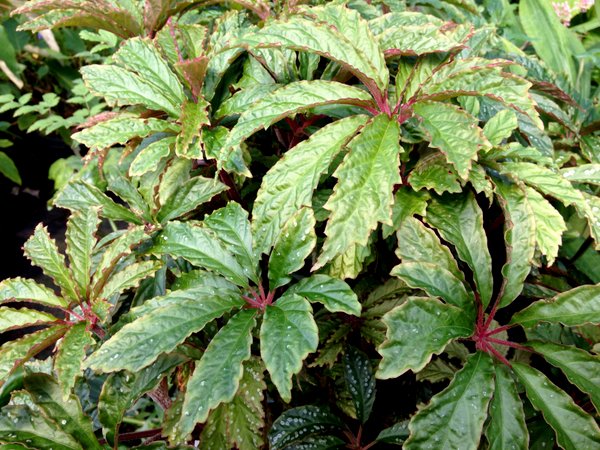
Eye-catching species from China with palmate leaves spritzed with white on top and a bright maroon underneath. The pink flowers are just another layer of adornment which always come as a bit of a surprise to us as we are always completely satisfied with the leaves alone. Another surprise is the hardiness which is zone 8. If winter is going to push the lower limits of that zone for any length of time, be a bud and take care of your homie with a little mulch. This is slow to go in the spring, waiting until June but it catches right up.


Very good plant in the upper echelon of perennials and highly valued for its mid summer blooms of thickly textured intriguing yellow flowers on the terminals of the stems. These get nice broad leaves on herbaceous stems that in shape are not unlike a Hydrangea. Imposing at maturity.


This is thought to be an intergeneric hybrid between 2 of New Zealand's shrubby daisies. This gives a fabulous textural addition to the Mediterranean garden like some happy marriage of heather and rosemary. Small white flowers cluster at the tops of the stems. Good drainage, tolerant of some dry.

A luscious, tender Nerine sarniensis hybrid worth every effort to overwinter. Related to Amaryllis, this bulb is summer dormant with the leaves appearing in winter and flowering in fall. The flowers are the rich pink of promise speaking directly to the limbic brain, conjuring ancient cave responses as though confronted by sex, ripe fruit or blood. Civilization is but a thin veneer. Basic culture is plant so bulb is partially exposed and let get somewhat dry between waterings and more so when dormant.

Grown from seed given us by the originator, Dr. Keith Ferguson and named for his wife, Lorna. They have grown this spectacular, heavy flowering selection for over 40 years in their garden in the Cotswolds. From the Maritime Alps, this resembles our native Veratrum viride with similar bold pleated leaves and green pendulous flowers but this elevates that look to a ridiculous level with its sheer volume of flowers on stems that can reach 8 feet! We have been also gifted seed from the late Michael Wickenden of Cally Gardens and our friend, the redoubtable German plantsman Christoph Ruby. The fact that this trio holds this in valued esteem, should be ample endorsement. Long-lived, hardy as the bejabbers (been wanting to use that for years) and deer resistant. These are young plants not of flowering size but give them a rich moist soil and a bit of amply rewarded patience.
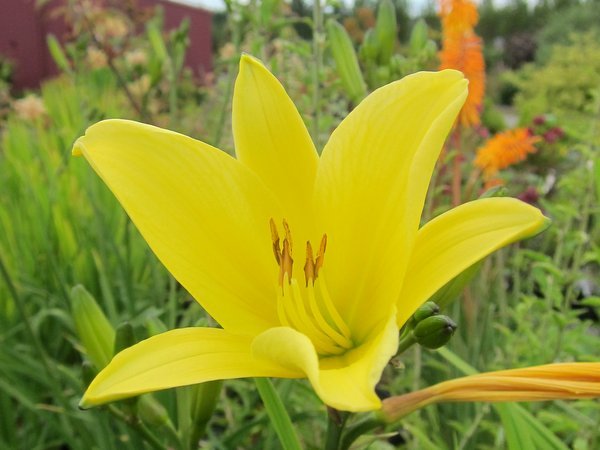
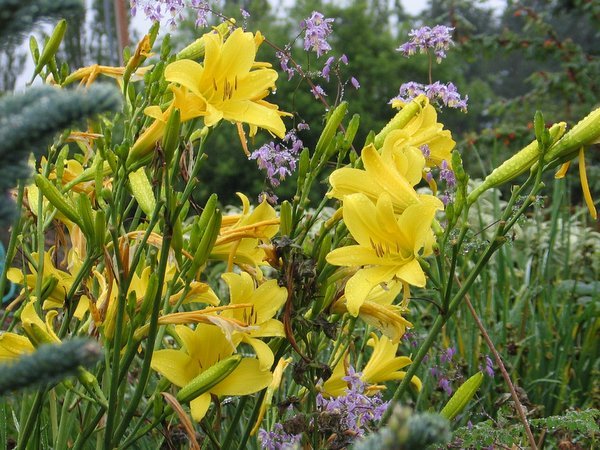
Antique hybrid nearly lost to cultivation but thanks to Jim Fox, we can keep this going. Jim visited Graham Stuart Thomas at his home in England and Graham handed Jim his spade and insisted he dig a piece. As if God himself spoke, Jim obeyed. This is the kind of provenance that makes the Keno brothers animated on Antiques Roadshow. Narrow elegant yellow flowers and fragrant in the evening, this is such a nice change from the huge modern hybrids as it retains a nice species look which we gravitate towards. It is important to keep these heirloom plants going as many of Perry's introduction are now lost to cultivation. Hybridized by Amos Perry who was one of England's first two Daylily breeders and he registered 'Thelma Perry' in 1925 as a hybrid with H. thunbergii as the pod parent and H. citrina as the pollen parent.


This is a gleaming bit of sunshine carried into your shadowed shade garden and released. The cupped leaves to just 5" high bring more light to their bit of turf than their size would suggest. The small light lilac flowers are nice but incidental because with this Hosta it is all about the glow.

This former Anemone is one we first became acquainted with in John Massey's impeccable garden at Ashwood Nursery. We didn't know what it was but it grabbed our attention which is saying something in that candy store of a garden. A small plant that would be well-suited for a moist rock garden setting, it has simple, soft yellow flowers and distinctive green leaves.

Dark-flowered form from a wild collection in Turkey. The typical form cultivated in the Northwest is a soft blue lavender but this is a rich blue purple with falls marked at the base with prominent white feathers around a peninsula of yellow. Closely allied to Iris unguicularis, this has wider more substantial foliage and flowers later - usually in March here. Special indeed!


Given the Award of Garden Merit in the UK, this is truly a winner with icy blue, ferny foliage subtending the dangling white heart-shaped flowers. A superb form of our western native and deserving of a place in any garden. Can you tell we like it?

Very nice Chinese member of the African Violet family that is surprisingly hardy and well suited to milder gardens here in the Northwest. We have friends in North Vancouver BC who have grown this beautifully for years in their moist woodland garden. This would typically grow on mossy rocks in the wild. Yellow tubular flowers. Not that we're big fans of the genre but having watched the movie 'Transformers' on a flight back from the UK, we think Tremacron would be a great name for one of those big robot things.

A very distinct form of this species which was collected in Nepal by Tony Schilling and shared with us by David Mason of Hedgerows Nursery. A good spreader rather than a clumper, the rounded ping-pong paddle leaves offer much as a small-scale groundcover. White to tinged pink flowers in early summer. Deciduous to semi-deciduous, we are inordinately fond of this collection and have it planted at the entrance to our shade garden. This particular collection is quite rare in the trade. Tony used to be the director at Wakehurst and David was deputy director so the chain of provenance custody is just how we like it.

These Japanese versions of the European nobilis are ones we have grown from seed and have been hoarding for a few years but since there is no room left in the Hepatica house, we must send a few of our kids out into the world. Each plant varies a bit but all are good pinks and we get to pick. These good-sized plants are home-grown by us - not imported from Japan. Also note that these are not as hardy as the European Hepatica but good for sure in zones 8-9a.
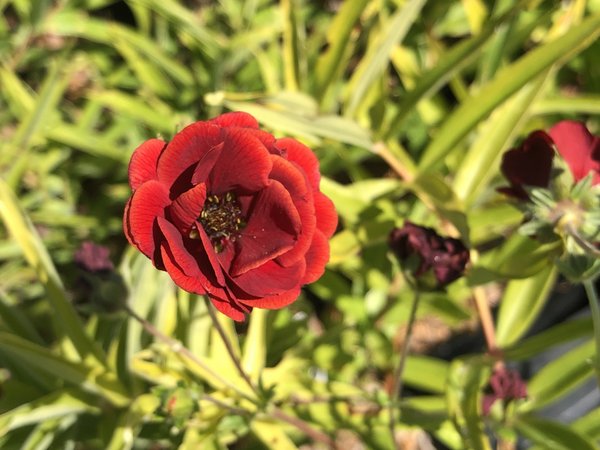
One of the best of the herbaceous Potentilla hands down, period. End of story. George Zimmer of Men's Wearhouse "I guarantee it". This is a "Quit talking, just do me, baby" Potentilla. Deep blood red flowers combined with the silver foliage are an exquisite pleasure verging on pain. Full sun.

From great plant friends in Scotland, this showy cross of two fine Candelabra Primrose species garnered accolades when they used this to great effect in a display show garden. Colors are widely variable and size can be a bit shorter than the parents but literally, all are good and work well together. Now if only politicians............

A distinctly smaller form with wider and shorter leaves than any of the dozen or so clones we grow. This was found on the summit of Jinfoshan where it was growing in deep moss on top of hard limestone Stegosaurus outcrops in a miniature stone forest. We thought this might be a new subspecies at least but DNA puts it squarely in R. carnea. The scented pink and white flowers are much more visible in this form than in the typical range of the species and we felt it merited a clonal name.
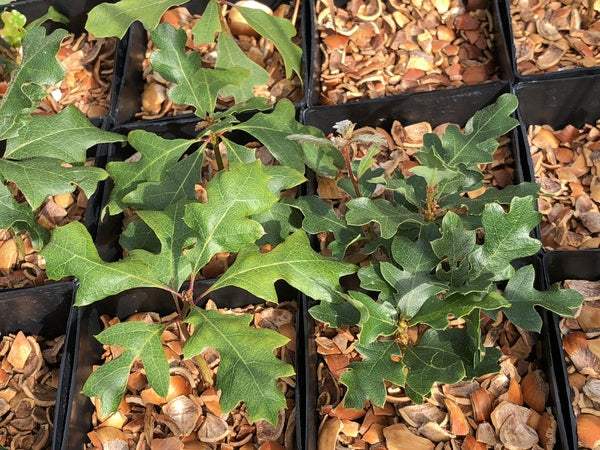
Oregon White Oak. This variety of Q. garryana hugs
the foothills of the western Sierra Nevada and southern Oregon. In its native
poor, rocky soils this becomes a multi-stemmed shrub or small tree to 20
ft. Deciduous and drought tolerant. Another excellent Oak we're able to offer
thanks to Ian Barclay of The Desert Northwest.

This Strawberry Saxifrage has rich colored leaves quite maroon underneath and intricately marked in silver on top. This sends out runners like a strawberry which makes new plants at the tips & makes a great groundcover for moist shade. Dandy and delicate white/pink flowers on 18" stems. This has proved itself in our shade garden.

A superb compact and very floriferous plant we got from the sadly late Michael Wickenden at Cally Gardens in Scotland. This is just about the perfect little container plant with low, dense tuffets of deep green narrow blades of leaves and a profusion of small white flowers on short stems which retain interest long after flowering with their seed heads. This would be an ideal plant for some plant factory to pick up for tissue culture to flood Lowe's and Home Depot with millions of these but we would ask that if there is any inclination to do so, know that Michael was vehemently opposed to this and that his wishes be respected. Because this is the new America, when conscience fails, please consider a gentleman's royalty on each plant to be sent to Cally Gardens.

Rubus can be scary but with this classy China species, it will be shivers of delight instead of fear. Graham Stuart Thomas "One of the finest of all foliage plants". 4'-8' upright somewhat arching canes. A clumper and not a vine with few small fruits, white flowers and no thorns