
188 products
Sort by:
188 products
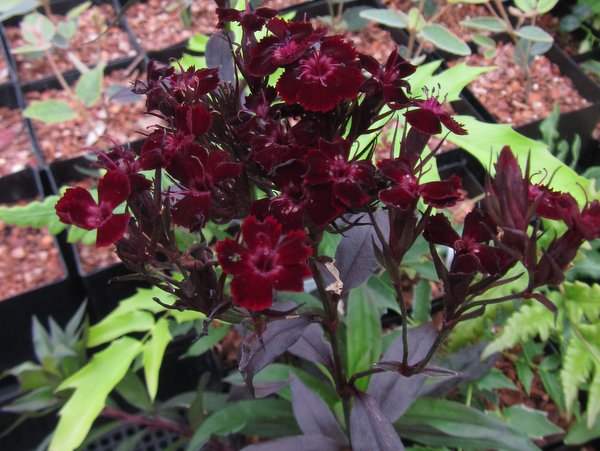
Awesome Sweet William selected by John Grimshaw from seedlings at Monksilver Nursery and is notable for the foliage which turns maroon-black providing the perfect foil for the velvety maroon clustered flowers which smells of chocolate in warm weather - damn! Cut back after flowering for another go around. John personally gave us a piece from his garden so we have a fond attachment. A Far Reaches Botanical Conservancy Offering. Proceeds from this offering go to support the mission of Far Reaches Botanical Conservancy.
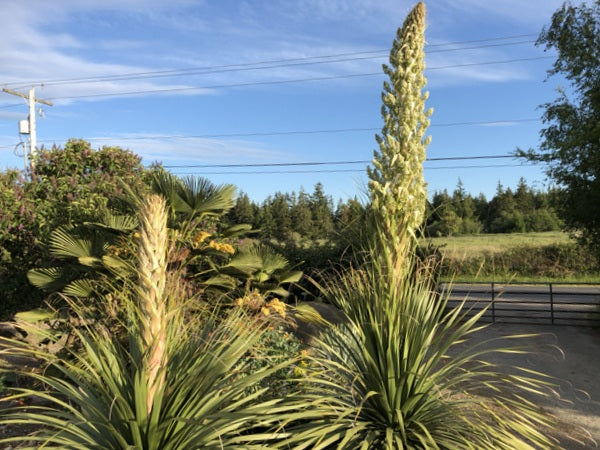
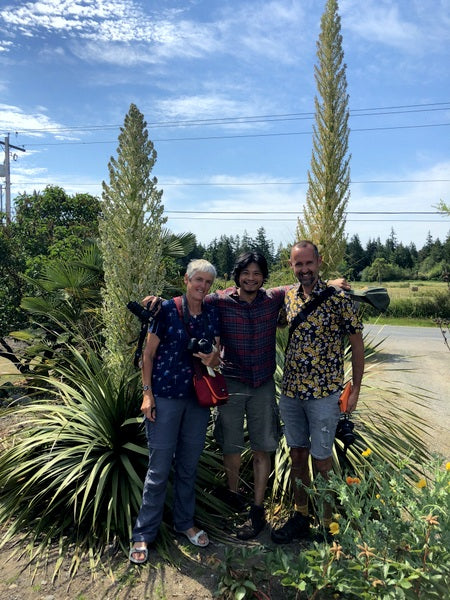
Originally introduced by Cistus Nursery from a seed collection at 8000' in La Siberica, Mexico, this very desirable plant has become hard to find of late but our two plants finally flowered with impressive spikes that was one male and one predominately female so we had seed! These have been undamaged in brief nighttime drops to 10F and have formed new crowns after flowering so the show will continue. It is mandatory to have a series of parties when these bloom, btw.
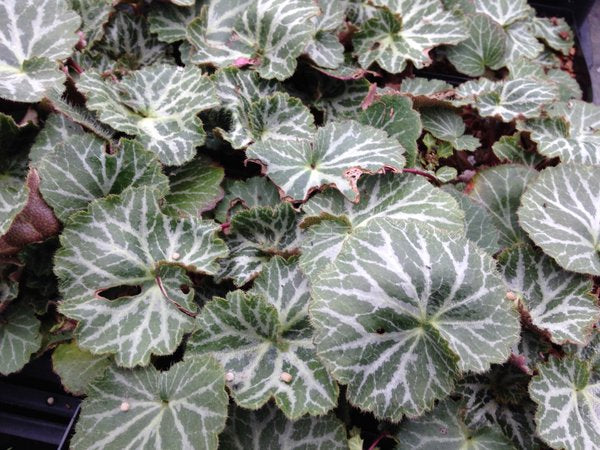
A superb collection of this Strawberry Saxifrage by the Wynn-Jones of Crug Farm who found this in the Hsitou area of Taiwan. Fantastic green leaves variegated in silver-white and while it could be our imagination taking wing after being bowled over by the foliage, the white flowers seem larger than usual on their 18"-24" stems. Moist, shade, zone 6-9.
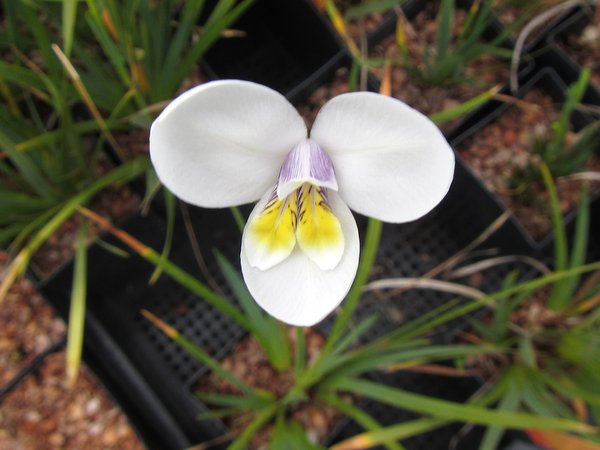
Butterfly Iris. In the Iris family from Tasmania and New South Wales, this makes a substantive clump of thin evergreen leaves with tall wiry stems holding enchanting white flowers well above the leaves. Grown for decades in the Seattle garden of Jeanette Kunnen.

One of the better grasses you will find as this has impeccable manners coupled with tasteful presentation. A dense and self-contained spiky green mound of thin green blades gives rise to dark-stemmed flower spikes which can reach 30" tall and are at their best in late summer to autumn. Came to us via Marchant's in the UK.

A very distinct form of this species which was collected in Nepal by Tony Schilling and shared with us by David Mason of Hedgerows Nursery. A good spreader rather than a clumper, the rounded ping-pong paddle leaves offer much as a small-scale groundcover. White to tinged pink flowers in early summer. Deciduous to semi-deciduous, we are inordinately fond of this collection and have it planted at the entrance to our shade garden. This particular collection is quite rare in the trade. Tony used to be the director at Wakehurst and David was deputy director so the chain of provenance custody is just how we like it.

A distinctly smaller form with wider and shorter leaves than any of the dozen or so clones we grow. This was found on the summit of Jinfoshan where it was growing in deep moss on top of hard limestone Stegosaurus outcrops in a miniature stone forest. We thought this might be a new subspecies at least but DNA puts it squarely in R. carnea. The scented pink and white flowers are much more visible in this form than in the typical range of the species and we felt it merited a clonal name.


An exceptional collection by Steve Hootman, Ken Cox and us of one of the finest Hedychium species for our area. We collected the same species in the same area on the same trip as part of the NAPE expedition and the collections were merged under this number. This is an early and consistent bloomer with rich tangerine-orange dense flower spikes in late summer and early fall. Rich moist soil and mulch if winter is severe to keep frost from the rhizomes.This is significantly different from the other densiflorum we offer, being much more robust and taller to 5'. It also blooms about 6 weeks later, with deeper orange flowers packed much more closely together. This is very happy in our shade garden. Similar to, and perhaps indistinguishable, from Frank Kingdon-Ward's collection called 'Assam Orange' as he beat us to this remote area by 70 years. Quite a gap between collections! These are big divisions.

Seldom offered species and one we had the privilege to see in a very remote area in western Arunachal Pradesh in 2003. Well, Sue saw it as Kelly was confined to bed violently ill and missing this remains one of his great regrets. This originated from friend and plant legend Peter Cox of Glendoick. Pink to white flowers.

Gorgeous little gem out of Japan with a rich yellow center to the leaf surrounded by green with some nice feathering details. This will increase quickly but not aggressively and adds a nice splash of color in the shade garden. The white flowers go well with the whole package.

Himalayan Bush Mint. Surprisingly hardy species - the gestalt at first glance is gotta be tender - that will be valuable late summer-fall color. Soft felty leaves on a plant that can hit ten feet tall, you grow this not for the aromatic and pettable foliage but for the tubular orange-red flowers in September-October mainly. Cut to the ground by hard frost but will regrow and would totally groove on a wall in its colder zones. Pronounced ko-hoo-nia.

Sweet little evergreen groundcover from southern Taiwan where it grows at low to mid elevation in littoral thickets. Then there are the virtual thickets.... Small rounded leaves and yes, there are very small figs but it would take a lot to make figgy pudding. Zone 8 hardy and grows at the Zone 7 Raulston Arboretum in a sheltered spot where it is deciduous in cold winters. Tolerant of shade.

Rare species from Taiwan collected by botanist Pascal Bruggeman. This is evergreen in mild winters and has late spring subterminal clusters of pendulous bells the color of a perfect flan with tips of the tepals looking as though dipped in chocolate. A rhizomatous species but so not a thug for us.
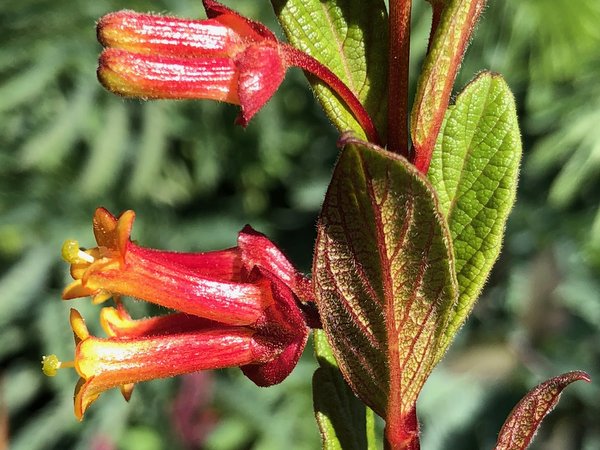
Twinberry Honeysuckle. This the southern variant of our native shrubby Honeysuckle which here in Washington has tubular yellow flowers but down in southern Oregon and California, these flowers are little firecrackers of orangish-red. Tough plant liking wet sites but quite tolerant of drier spots. Hummers like this!
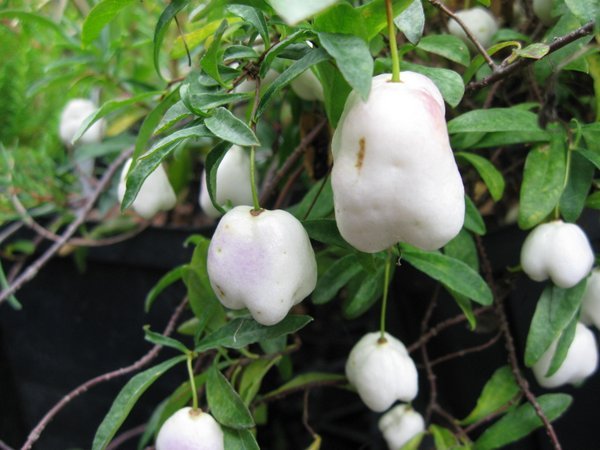
The white fruited form of the Tasmanian Blueberry Vine. The species is one of the choicest small evergreen vines and this white form is exceptional eye candy against a dark background. Mediocre chartreuse flowers and wild showy non messy marble-sized white fruit Aug to hard freeze.

We're wild about Roscoeas which we think gives you the floral abandon and exotic appeal of an orchid with a fraction of the cost and difficulty. One of the hardy ginger clan from the Indian Himalaya. These like a woodsy soil that drains yet stays moist. Easy and rewarding.

A Chris Chadwell collection from Nepal at 2500 meters of
this distinctive Iris in the Crested Iris section - Iris cristata and
Iris tectorum for example, are in that group. These are second generation seedlings from our plants grown from his original collection. This is a very distinctive iris with long stems - almost canes - which carry the fans of broad leaves and the flower stems to nearly 3 feet. The flowers are 2"-3" across of lavender blue with the falls taking on some white. This likes part shade in a moist situation and is best in zone 8 and above. Very architectural for an Iris with strong verticality. We had the opportunity to host Chris some time back while he was on a speaking tour - and arranged for a lecture in Port Townsend - and note that this year in 2015 he is offering to waive his lecture fees as a donation to the Nepal earthquake relief efforts. He has gone on many seed collecting trips to Nepal over the last 3 decades and has tremendous sympathy for the plight of the people and of the country.
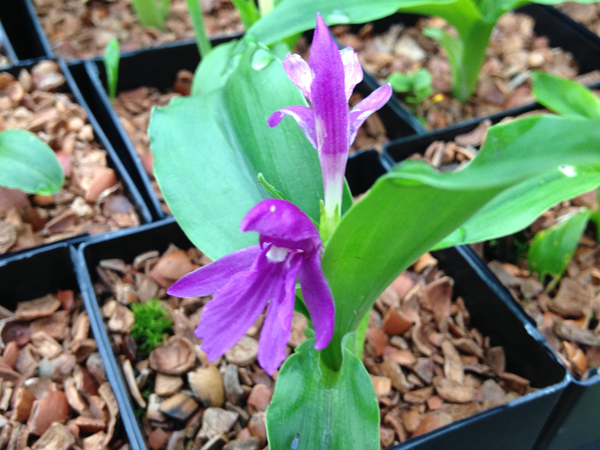
Our collection of this small Roscoea species where it grew in alpine turf. This sports wider leaves than R. scillifolia and with flowers of similar size. I realize this only helps if you are familiar with that species but the muse has disabled the backspace button. A 2020 study by Chinese researchers proposed that this be split from R. tibetica into a new species, R. lingbaoshanensis but we have not seen any formal description and this name has not been currently accepted. A hardy tuberous Asian genus in Ginger Family, Zingiberaceae, this will self-sow if allowed, to create a small turf itself.
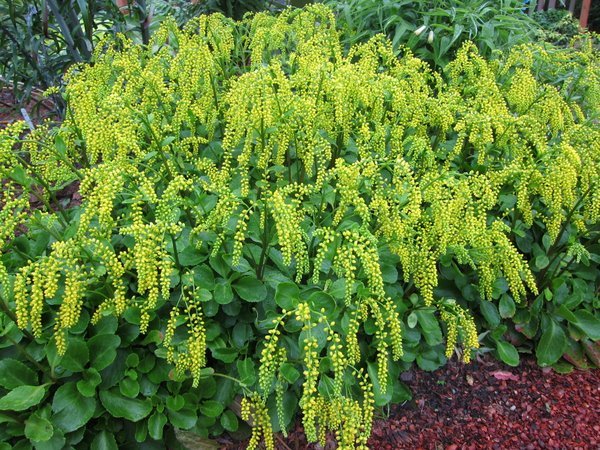
Excellent member of the Crassulaceae which means it is a succulent basically, but one that eschews the arid sunny spot in favor of lusher environs like our shade garden with dairy manure mulch. Makes a thick clump of fleshy green leaves with taller stems of pendulous strings of bead-like yellow flowers that are nothing less than captivating. This is one of those plants we have had for a long time but one that surprises us each year when it blooms because we don't expect something so familiar to float our boat quite so high. Very easy to please and a plant people want when they see it in flower.
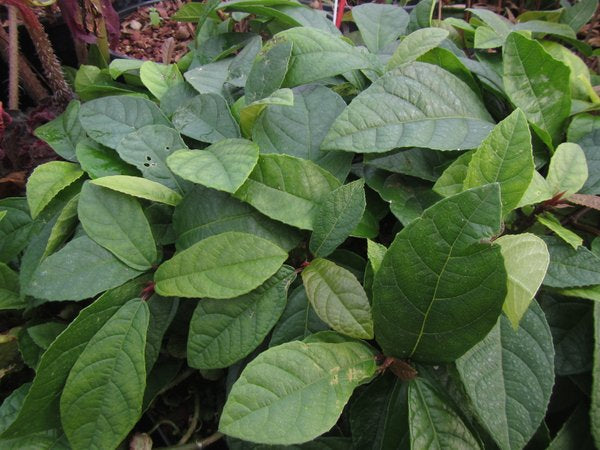
We first encountered this species in the fall of 1997 when we were on the mid to lower slopes of the Cangshan Mountains looking down to the barely discernible 3 Pagodas of Dali fronting the broad expanse of Lake Erhai. This groundcover species formed broad carpets of evergreen foliage covering the large rocks on the boulder-strewn slope so as to give the impression of a tumultuous green sea frozen in place. The day sounds much better than it was, for back in 97 there was but a rough single track road to the higher elevations and on that day our jeeps were blocked by a massively overloaded lorry whose driveline had failed under the weight of massive marble blocks quarried from the higher reaches. The truck was gradually sinking into the mud with just a few inches of clearance and a young skinny boy had been fetched from downslope to slither underneath and effect repairs, which was going to take many hours at best. This meant we were stranded at low elevation with a bunch of botanically fascinating, marginally hardy plants which was not our goal. We made the best of it and one of our new acquaintances was this Ficus.
We were pleased as punch when our friend Jim Fox gifted us with cuttings he took from Roy Lancaster's garden where it is growing as a foundation plant against his home. It was not a stretch to think that this plant was from the same population we had seen as Roy had traveled this same road years earlier as part of the Sino-British Expedition to Cangshan. Sadly we can't grow this outside here in our gardens but if you are lucky enough to have only very light frosts or none at all, then this would be a fine groundcover. This does have small reddish figs but stick to the ones you get at the store.
We were pleased as punch when our friend Jim Fox gifted us with cuttings he took from Roy Lancaster's garden where it is growing as a foundation plant against his home. It was not a stretch to think that this plant was from the same population we had seen as Roy had traveled this same road years earlier as part of the Sino-British Expedition to Cangshan. Sadly we can't grow this outside here in our gardens but if you are lucky enough to have only very light frosts or none at all, then this would be a fine groundcover. This does have small reddish figs but stick to the ones you get at the store.