188 products
Sort by:
188 products


Never enough of these whimsical epiphytic blueberry relatives with their chunky lignotubers and whimsical tubular flowers in a seemingly infinite variety of colors and patterns. Luckily thanks to our favorite local Ericaceae dealer Steve Hootman we are never long without. This collection flowers with white, slightly fuzzed flowers tinged green at the base and tips. The densely hairy arching stems and glossy leaves are good enough on their own, especially when they are flushing new foliage in salmon tones. Particularly vigorous and easy to keep looking nice as compared to its fellows in the genus, may have some hardiness as well.

Perseus had to best a sea monster to get his Andromeda, and Sue had to cart hers all the way from Vermont for us to offer them. Meanwhile all you have to do is shell out a few measly shekels to get yours, modern-folk and their convenience economy I guess... Anyway it's easy to see why Sue was so attached and why this sole member of the genus was bestowed the name of a legendary Greek beauty. Slender glaucous leaves that lend it the more mundane name of bog rosemary form an elegant evergreen mound worthy of a spot even without flowers. Flushed pink lantern flowers which mark the plant as Ericaceae (and at their best can almost entirely cover the plant) are deserving of a detour on your winged flight aboard Pegasus. Likes moist to wet feet and needs a cool summer climate to thrive but will tough out even the coldest winters.

This exquisite Pyrrosia was shared with us by the ever-travelling plantsman Adam Black from his own collection in Taiwan. Imagine our suprise when on a stroll through the nursery with Adam we discovered we were now the sole keeper of this and its twin collection, that is until we got the great pleasure of returning it to Adam's keeping. Conservation at work baby! Now you can join us in that great effort and hopefully if we ever suffer tragic losses you can be our backup! The species matsudae is a bit infuriating taxonomically, in appearance it is VERY similar to Pyrrosia polydactylos, though it can be distinguished by the lack of uniformity in frond lobing. Adding to the confusion some sources have inexplicably lumped it with P. davidii which having many collections of that species is very much different.
All of this probably means very little to you and you are simply drooling over the felty multi-fingered deliciousness presented outwardly, us too. This has proved hardy for us thus far in our collectors garden and wants the usual well-drained but moist, shady, preferably epiphytic situation as its brethren.
A Far Reaches Botanical Conservancy Offering


We grow an unreasonable amount of different Ophiopogon or mondo grass species and varieties. Unreasonable because they mostly just fuse together into one globular grassy ball in the mind due to their lack of distinguishing characters. The forbidden blue jelly beans of this particular collection are vivid as ever. Wild collected umbraticola is good enough already but if that's what this is then it is a particularly fine form with a large profusion of both flowers and fruits, with the latter being on the larger side of those we have encountered. Being called "dwarf" must have given these a Napoleon complex that led them to excel in other areas...

We understand if you have written off Hypericum entirely as a genus, but try not to judge this fella by the sins of his forefathers he's really quite an interesting chap once you get to know him. Eschewing the promiscuity and vigorous advances that has given its family a bad name this species native to Spain's Balearic islands stays quite small and contained, it maintains the redemptive golden flowers you know but the leaves are transformed into minute, lustrously evergreen ones that are not dissimilar to a crinkle-cut fry in silhouette. The stems add to the textural feast of the leaves with their scaly texture. Wants sharp drainage and makes a good rock garden or sandy spot addition.

Long confused with Pyrrosia lingua or simply listed as Pyrrosia sp. there are a few collection of this species floating around the PNW, the key to distinguishing is the fluffy fuzzed rhizomes and the wide prominently veined fronds. It has proved quite vigorous here in pots growing quickly on long rhizomes and would make an excellent stumpery subject as I suspect it does the Rhododendron Species Botanical Garden. This particular collection hails from North Vietnam and while we haven't yet trialed it outside we expect it will prove hardy here.
A Far Reaches Botanical Conservancy Offering

We have long sold the iconic Chilean fire tree but are delighted to finally offer some of wild origin, thanks Cody! The reasons for this are twofold, one we always prefer wild-origin material due to its usefulness to botany, science, and conservation but also because we have observed a fair bit of variation in the Embothrium we have seen in Chile. That same variation is rare or non-existent in cultivation so we hope to begin remedying that, with your help of course! This collection hails from near the town of Valdivia, which shares its name with the incredible Valdivian rainforest ecosystem, and is distinguished by being unusually narrow leaved.
Being in the Proteaceae, they don't enjoy phosphorous so be careful what you fertilize them with - it is the P in the NPK ratio to which they are allergic

We have long sold the iconic Chilean fire tree but are delighted to finally offer some of wild origin, thanks Cody! The reasons for this are twofold, one we always prefer wild-origin material due to its usefulness to botany, science, and conservation but also because we have observed a fair bit of variation in the Embothrium we have seen in Chile. That same variation is rare or non-existent in cultivation so we hope to begin remedying that, with your help of course! This collection hails from the banks of Lake Llanquihue and has wider leaves compared to its sister collection CEH 2442 but are relatively similar to the standard in cultivation.
Being in the Proteaceae, they don't enjoy phosphorous so be careful what you fertilize them with - it is the P in the NPK ratio to which they are allergic

Small cutting-grown plants of this truly alpine Rhododendron growing in the highest reaches up to 15,000’ Myanmar, China and Arunachal Pradesh. Our old plant came from our dear departed friend June Sinclair, who was one of the first plant hunters in China when this opened up in the 1980’s. Very small leaves back small perky purple flowers that universally delights while expanding your concept of what a rhododendron should look like. Light shade to some sun and appreciates moisture-retentive airy soil as it comes from summer monsoon climates. These are wee plants but well worth the wait.

We found this as a raggedy half-dormant plant in the midst of snow on Jinfoshan in 2010. It has taken us a long time since to both offer it and to appreciate its full-green growing season appearance. Staying quite small, only about 8 inches, and with adorably rounded leaves this isn't going to wow anybody but is an absolutely perfect negative space or filler plant carrying on the solomon's seal tradition of playing nice with everything while not taking up quite so much vertical room as the more traditional offerings.

A interesting oddity from the annals of the Far Reaches nursery catacombs. In yonder days we brought back on our jolly jaunt to the UK plants of Primula poissonii from our esteemed colleagues at Rumbling Bridge nursery, so enthralled were we with our species plant that we had the audacity to write (true) on the tag, inviting a curse of wanton succubus primulas which promptly assaulted our chaste new acquisitions. We have suspicions that the the lascivious demons to blame were somewhere in the spectrum of P. wilsonii but who's to say. Their sin-stricken offspring are more loosely held and a bit darker than poissonii. Romance novel fans, this one's for you.

A. villosa is widely grown in the rock garden world and widely distributed in the world at large. This variety however is something a little more uncommon, and with the distinction amidst other varieties of being stoloniferous, reaching out red hairy tendrils tipped by a colonial rosette produced by the mothership. This sort of imperial behavior is rightly shunned in modern geopolitics, but quite welcome in the garden. This is particularly true when each silver fuzzy rosette which composes the expanding territorial mat produces it profusion of hot pink, yellow-eyed flowers. A great beginner rock or crevice garden plant which is easily shared or divided and spread around.
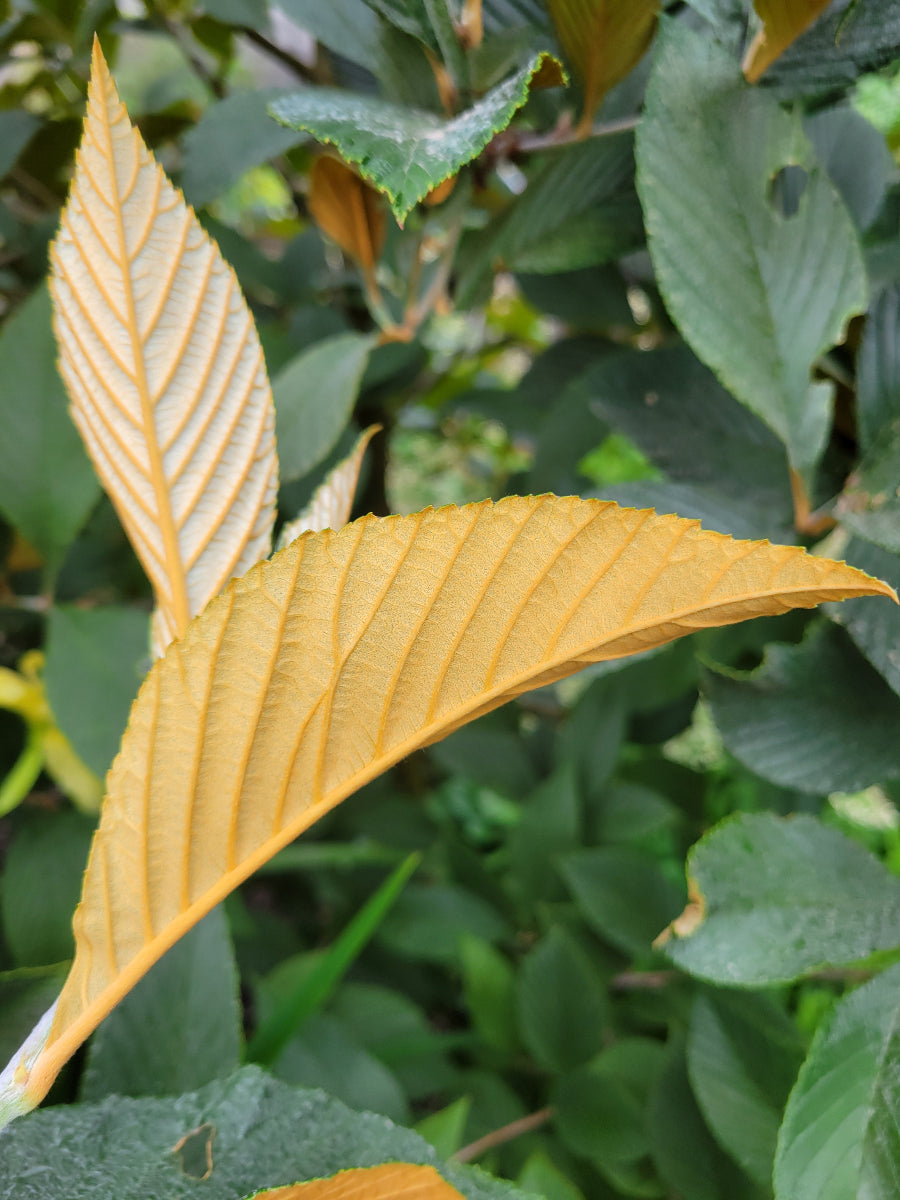
As a plant hunter and explorer, it doesn’t get any better than being part of a team that finds and introduces a species new to science and we were tasked with growing this from very limited seed. It is even better when that species is not new because it is obscure with minor taxonomic differences from other known Asian species but instead, waves those richly ornamental characteristics like a flag. The main feature that jumps right out at you on this entire-leafed tree is the tawny amber indumentum on the underside of the leaves which tantalizes spring into fall, the latter time enhanced by the orange-red fruit. This has also been collected by a French nursery from a different area but likely the same mountain range. This very limited offering is from one clone propagated by cuttings.

Seedlings from our plant grown from wild collected seed so second generation plants from South Africa. Dieramas are a promiscuous lot so expect flowers in shades of pink to edging on lavender possibly. To 3' or more in full sun and mulch in Zone 7 if winters are cold.


The whole nursery staff comes a runnin' to gawk at the brown flowers of this delightful little wild gesner. "Running...for BROWN flowers!" you ask incredulously in your garden office surrounded by a utopia of lovely colored, sweet smelling beauties. Yeah, we're in deep - and we're gonna drag you down with us! Growing as a lithophyte in the wild, with smoother leaves than most Oreocharis of a texture not unlike leather. Attractively indumented below with you guessed it: brown.


One of the Asian hornbeams longest in cultivation, as well as one of the most graceful, yet still sadly rare particularly here in the US. Most introductions trace back to the Himalayas and China, whereas this is possibly the first from Vietnam collected and shared with us by Aaron Floden. Gently drooping branches and pendulous catkins give a soft weeping effect (particularly good in this clone) without the messiness of a true weeper. A beauty and with good hardiness for its origins surviving -6 F in Aaron's home garden.

Imagine prizing open the rigid and unrelenting fingers of one Kelly Dodson and wresting from him prized jewels and precious heirlooms. A scenario not far from the one that has finally made this exquisite Central American bulb available to you, our beloved customers, for whom we endure much separation anxiety and grief. The flowers like little flames must be very akin to the will-o-the-wisps in their native cloud forest, luring unwary travelers to an endless curse of botanical lust. Desirous of moist, well draining mix and not amicable to deep frosts. Bulb at or near flowering size.

Plants from wild seed of this Himalayan Bergenia species that we seem incapable of having too many different collections of. Its easy to see why when the red flushed new leaves arrive. Those leaves are smaller than other species and form a nice low mat with dark pink flowers in the Spring.


Yet another of diverse and headachingly difficult to identify genus that love but doesn't love us back (at least taxonomically). The dark, opaque, and serrately margined rhizome scales have led us to believe it belongs in the section pseudovittaria where the publication helpfully states species delimitation is particularly difficult. Whatever the species it is an attractive small evergreen species that grows epiphytically in the wild and while spreading by rhizome tends to form a nice tight clump overall. The fronds start off broader and slightly twisted but become thin and much more upright as the sori develop. This has proved hardy for us thus far in the tufa wall housed in our collector's garden and has drawn the particular admiration of a few very knowledgeable local fern fanatics.
A Far Reaches Botanical Conservancy Offering
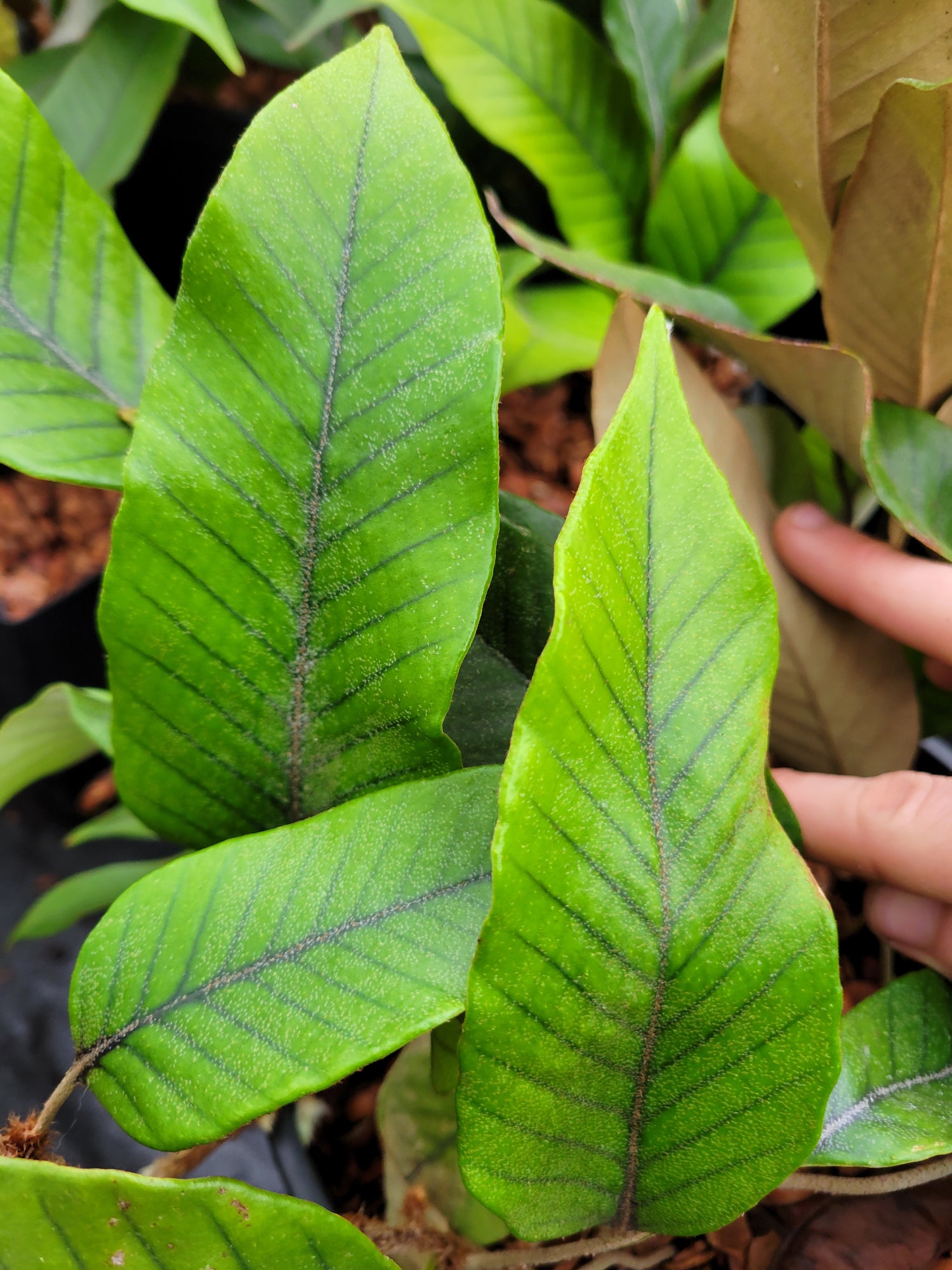
The myriad of skinny little wimp linguas flee before the broad shouldered chad heteractis with its rippling dimorphic chest hair of stellate boat-shaped rays and rich wooly under layer, so says the Flora of China's arcane key . At least that's how I remember it. All this to say that this exciting little number we collected in Yunnan boasts wider fronds and more uniformly attractive indument than the more commonly offered Pyrrosia lingua. Rare to see this species in cultivation (though it's possible some linguas or "sp."s in the market are actually heteractis) and the elevation of this collection leaves some question as to its hardiness as compared to those finally reaching the mainstream but rarity and risk often go hand in hand.
A Far Reaches Botanical Conservancy Offering