
1721 products
Sort by:
1721 products


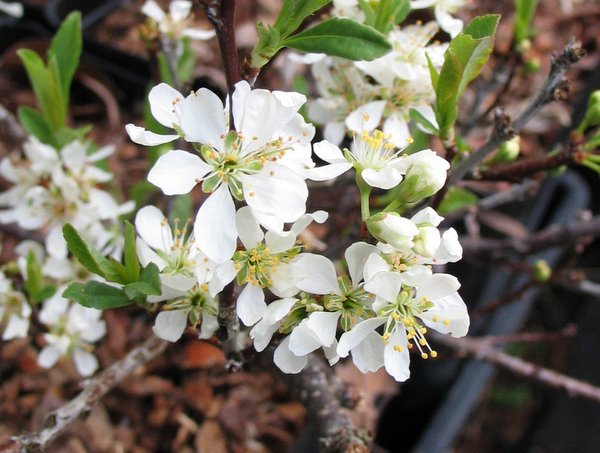
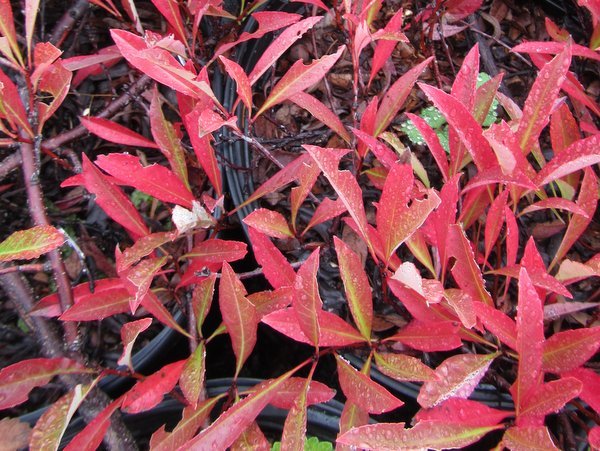


When is a fern not a fern? When it is in the Poppy family which is where this choice bit of Japanese fern mimicry resides. Perfect fern-like leaves which we could easily mistake for a Blechnum (Deer Fern) until the spikes of purest white flowers appear in late spring. Lovely plant for turning a supposition on its ear as well as classing up the joint. This is an especially good crop freshly potted and even though for the next few weeks the roots will not fill out the pot, we have zero concerns about these successfully transplanting to your garden.
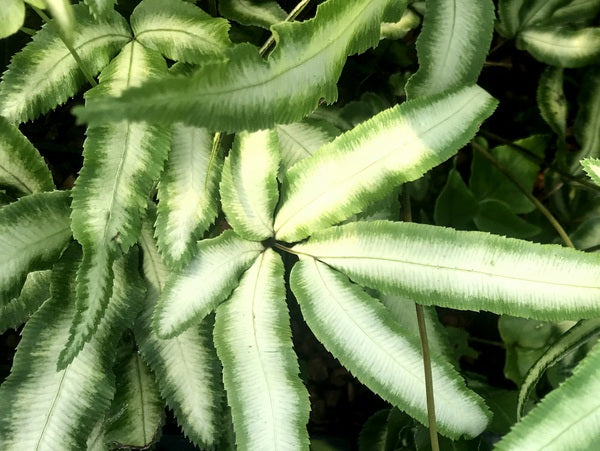


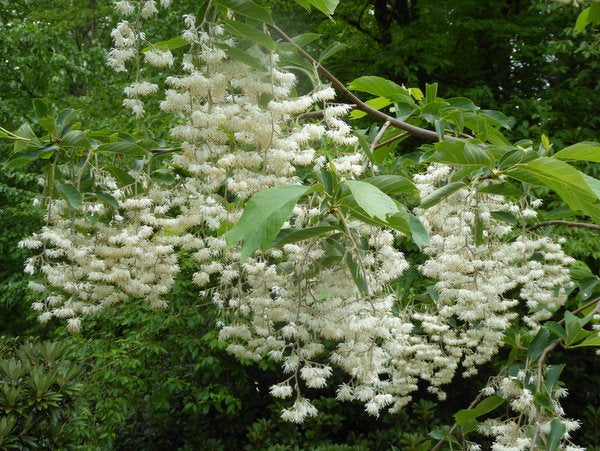
Our collection from Asia of what is likely the first introduction of this exceptional form of this equally exceptionally rare variety. Attractive leaves that are terminally cleft into bilateral lobes. The 12" long hanging panicles of white flowers are the finest in the genus, holding their own among the best of flowering trees. So much better than the straight species. Seed-grown younguns from the original plants. Who's your plant daddy!!!!! Photo credit to Steve Hootman. Proceeds from this offering go to support the mission of Far Reaches Botanical Conservancy.

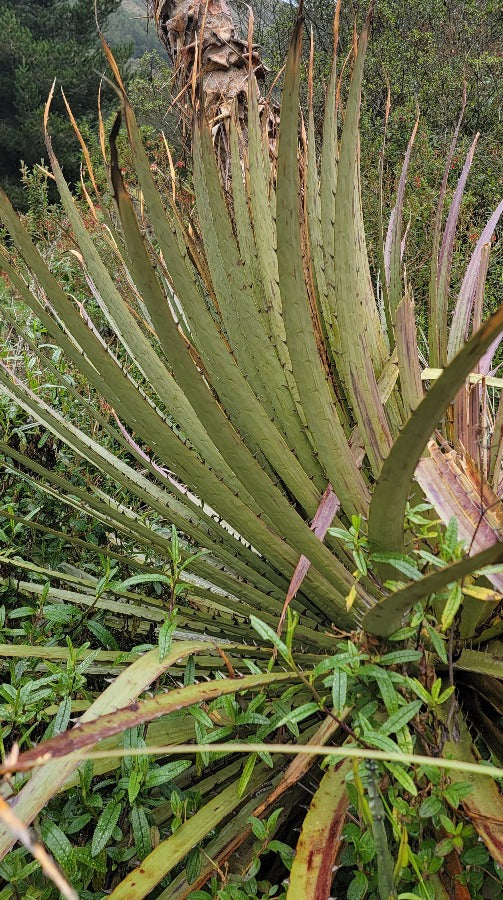
Collected in Ecuador at nearly 12000', this bromeliad will certainly tease with possibilities of hardiness. The stiff evergreen sword-like leaves are well-protected by evenly spaced sharp teeth which are the pinnacle of personal protection against herbivory. Critically, they guard against unwanted advances upon the infrequently produced stiff flower stem whose stoutly erect bearing is regarded either as a triumph of botanical engineering or the epitome of salacious horticultural projecting. The many stemless flowers were not seen but are arranged in stimulating tight spirals up the upper half of the thick vertical shaft. Growing on slopes in the humid páramo zone of mixed grass-forb-shrub communities with wide temperature swings and ample water from rain, clouds, fog and frost.

Long confused with Pyrrosia lingua or simply listed as Pyrrosia sp. there are a few collection of this species floating around the PNW, the key to distinguishing is the fluffy fuzzed rhizomes and the wide prominently veined fronds. It has proved quite vigorous here in pots growing quickly on long rhizomes and would make an excellent stumpery subject as I suspect it does the Rhododendron Species Botanical Garden. This particular collection hails from North Vietnam and while we haven't yet trialed it outside we expect it will prove hardy here.
A Far Reaches Botanical Conservancy Offering
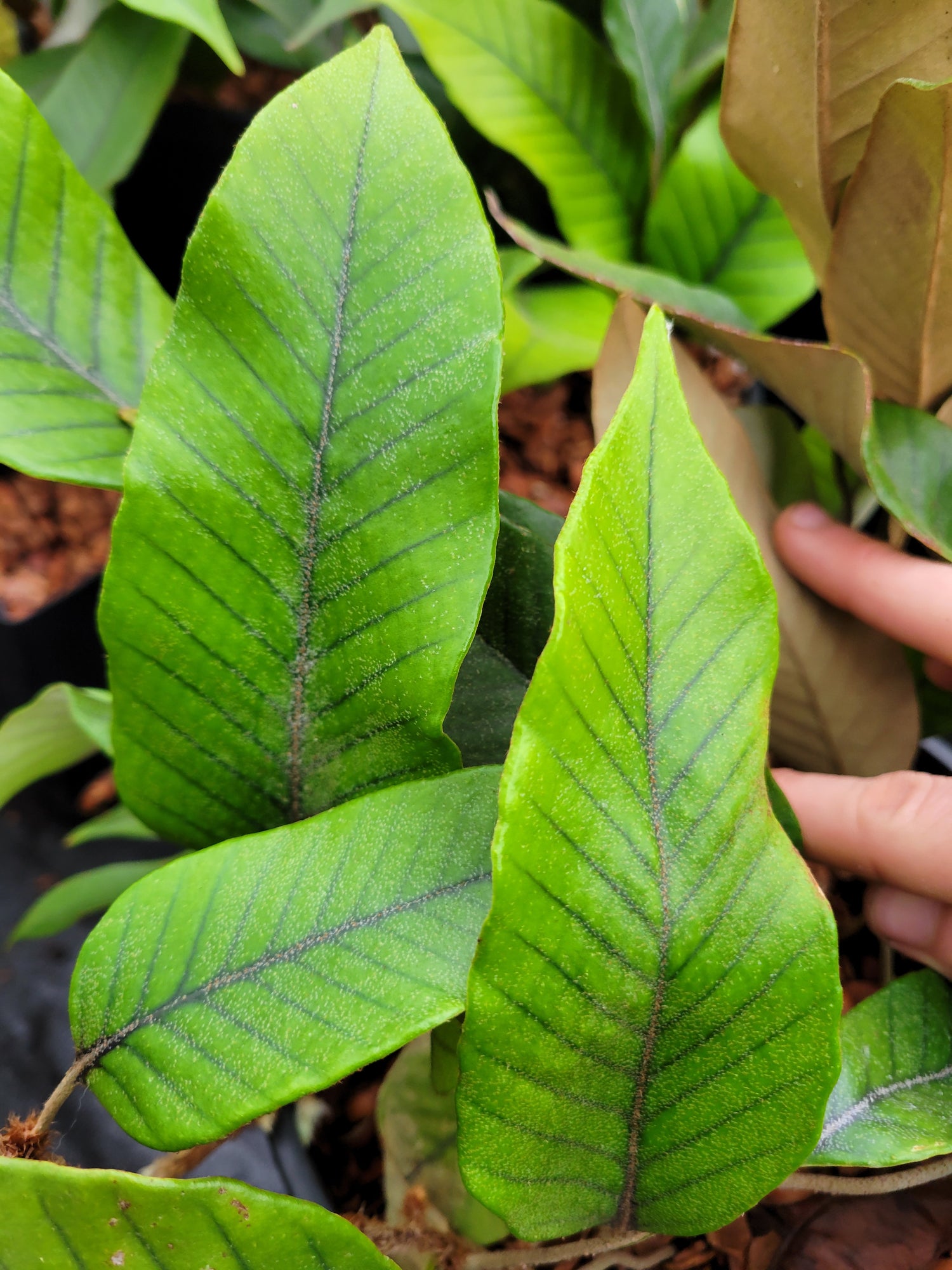
The myriad of skinny little wimp linguas flee before the broad shouldered chad heteractis with its rippling dimorphic chest hair of stellate boat-shaped rays and rich wooly under layer, so says the Flora of China's arcane key . At least that's how I remember it. All this to say that this exciting little number we collected in Yunnan boasts wider fronds and more uniformly attractive indument than the more commonly offered Pyrrosia lingua. Rare to see this species in cultivation (though it's possible some linguas or "sp."s in the market are actually heteractis) and the elevation of this collection leaves some question as to its hardiness as compared to those finally reaching the mainstream but rarity and risk often go hand in hand.
A Far Reaches Botanical Conservancy Offering

This diminutive Felt Fern is widely distributed in China and Taiwan and differs quite markedly from the increasingly ubiquitous Pyrrosia lingua with 6" strappy leaves soft as the ears on our friends' new kittens, Oliver and Stanley. This would be found as an epiphyte in trees or shaded rock outcrops or cliffs that are moist, where it grows nearly horizontal. Would make an excellent stumpery groundcover element.


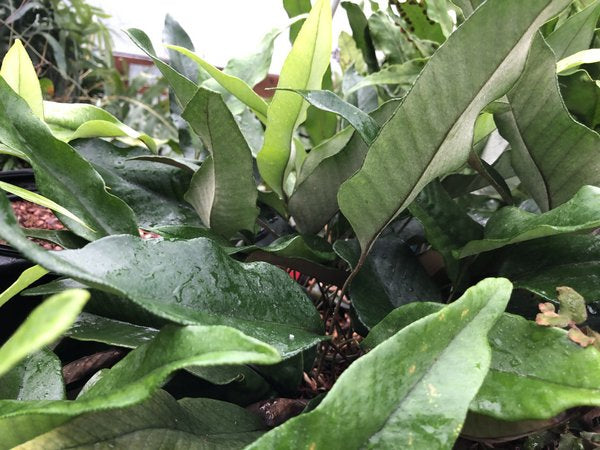
Our collection from Asia of this foremost member of one of the supreme evergreen fern genera. A great introduction to epiphytic fern growing this glossy fronted, and felt-backed tongue fern trails on thin rhizomes to cover rocks and stumps, though its equally happy in a pot. This formed an impressive colony on the bluff overlaying a partly shaded large rock slab where it would endure periods of dry. Vigorous! Good drainage is important.

This exquisite Pyrrosia was shared with us by the ever-travelling plantsman Adam Black from his own collection in Taiwan. Imagine our suprise when on a stroll through the nursery with Adam we discovered we were now the sole keeper of this and its twin collection, that is until we got the great pleasure of returning it to Adam's keeping. Conservation at work baby! Now you can join us in that great effort and hopefully if we ever suffer tragic losses you can be our backup! The species matsudae is a bit infuriating taxonomically, in appearance it is VERY similar to Pyrrosia polydactylos, though it can be distinguished by the lack of uniformity in frond lobing. Adding to the confusion some sources have inexplicably lumped it with P. davidii which having many collections of that species is very much different.
All of this probably means very little to you and you are simply drooling over the felty multi-fingered deliciousness presented outwardly, us too. This has proved hardy for us thus far in our collectors garden and wants the usual well-drained but moist, shady, preferably epiphytic situation as its brethren.
A Far Reaches Botanical Conservancy Offering