440 products
Sort by:
440 products

A collection from our friends at Keeping it Green and Chimacum Woods of this thin bladed Iris named for the great plant collector George Forrest from whose collections it was originally described. From the same group as Iris sibirica which in my opinion contains some of the nicest garden Irises to be found with their medium size and plentiful flowers that toe the line of elegant and flouncy. This is the yellow form of the species which also comes in a near-black color, you could plant them together to warn off garden predators hungry for your valued plants.

This was an incidental find as we botanized along a small stream in a rich deciduous forest sprinkled with a remarkable variety of broadleaf evergreen shrubs. We had a hard time looking above the ground as it was a scatter garden of Ophiopogon, Asarum, Reineckea, ferns and more Hepatica henryi than we ever imagined seeing. There was a small Sanicula out of flower but we hoped it would be the blue-flowered Sanicula coerulescens which we have grown for many years, although the leaves on this looked a bit different. Once we flowered the seedlings, we were delighted with the blue flowers and said "Another form of Sanicula coerulescens"! But then it kept growing and eventually was not unlike a foliar basketball in the garden which is so not coerulescens! Far Reaches plant locksmith, Silas, worked the Sanicula key and with ample caveats that there are few good comparative images online, pronounced it may be Sanicula orthacantha. Rare or absent in cultivation despite it ranging from India through China into Vietnam and Cambodia. Shade and moist. Zone 6 or lower.

This wild-collected Sichuanese Polygonatum has the province's signature added spice in comparison to the usual Polygonatum prattii. These grow to only about half the size (3-4") and have attractive red-purple stems, and new leaves suffused in the same peppercorn hue. No chewing required to experience delightful tingling, in fact please don't. Quite hardy, and happy in a shady spot with decent moisture, small pink vanilla-scented flowers.


This species is best known from the clone ‘Chocolate Stars’ which has been around for years and noted for its brownish foliage. This is not that but does have leaves in shades of copper when first emerging that later morphs into various green realms as the season progresses. Likewise, the flowers for us start out white in the early part of spring and later are softly lavender. These are rare second-generation plants from our own wild collection for those plant collectors (Me! Me!) who appreciate seeing alternative expressions of a species. Fast-growing in moist light shade with white to lavender tubular flowers followed by narrow reddish seed capsules. This will self-sow so we just pull off the seed-bearing stems leaving the fresh new foliage to fill out the plant. We leave a stem or two just so we can have a few seedlings to pot up. Any unwanted seedlings are weakly rooted and a literal snap to remove.


A very rare member of this famously lustrous fern genus, this species is found only in two provinces of China. Possessed of delightfully round fronds that never fail to elicit cries of "that's a fern!", and that each with their glossy, pebbled texture look very much like fallen scales of some great dragon or dinosaur. The magic continues when the acrostichoid sporangia emerge, cloaking the entire back surface in what looks like fine black soot. Flora of China describes the rhizomes as long creeping but this hasn't been the case for us thus far as they have plodded along with small clumps with only a few new leaves at a time. We recently planted this out in our tufa wall and it already shows signs of increased vigor though so perhaps it just dislikes the confines of black plastic. Cold hardiness to be determined but we feel good about its chances in the PNW, a rocky substrate is desirable and a touch less moisture than most ferns.


A collection by Iris-king Darrell Probst of the well-named bamboo iris. Not the plants of Van Gogh or your grandma, these grow as a series of stout green stems that hold aloft leaves which would be at home in the hands of an aristocratic lady fighting off a summer-time faint. That faint may well have been elicited by the elegant flowers of the palest lilac imaginable which come in small groups. Proof that even classic genera can offer the strange and wonderful.
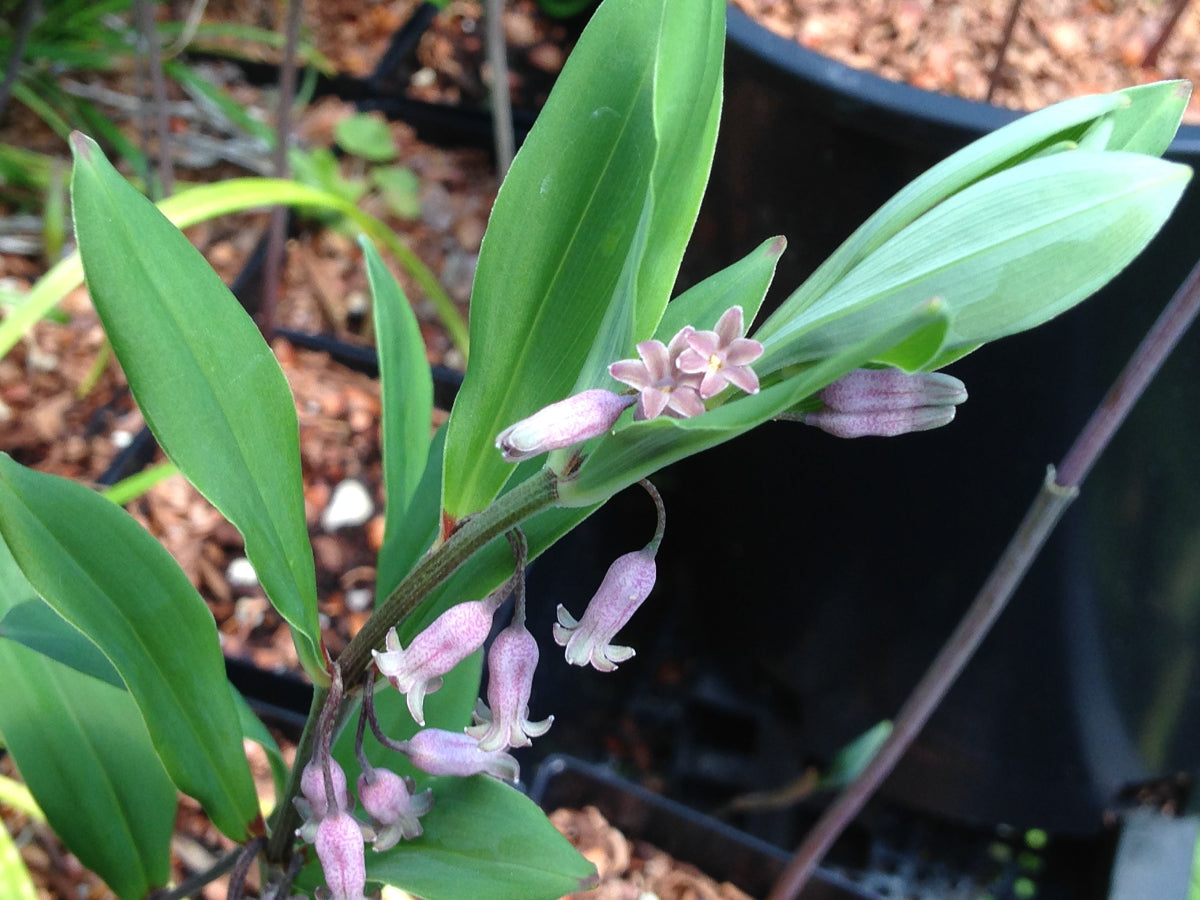
Scented Solomon Seal. Our collection from 10000' of this vigorous form of the species identified for us by Dr. Aaron Floden. We have other collections of this species which get just 3" tall but this collection gets near 3x that. The expected soft-pink bells are scented which is an endearing, if subtle, attribute.


Our long-ago (1997) collection of this widespread in nature but poorly represented in cultivation Rhododendron species. This has little to do with its appearance as the petite indumented evergreen leaves and delicate blushing white flowers create quite a handsome overall appearance on a manageably sized plant to boot. Their quickness to bloom and adaptability to various light regimes only add to its garden-worthiness. Unfortunately the hardiness leaves something to be desired, may be doable in a low zone 8 but 8b and up to be safe.


Our collection from Guizhou in an area famed for its vast diversity and density of Rhododendron species. It was really quite staggering to see the Rhododendrons dominate the landscape even in the fall when all was out of flower. This little Mondo Grass grew as part of the herbaceous understory and had narrow evergreen leaves to 6" with 8" flower stems bearing up to 7 glossy blue-black fruits. Part of our mission here at the nursery is to provide wild-sourced plants in genera that is confused taxonomically in hopes more light can be shed. A portion of the proceeds goes to the Far Reaches Botanical Conservancy.



On the spectrum of hardy aroids Pinellias fall somewhere between Arum and Arisaema with the attractive heart shaped leaves of the former and the hooded long-tongued flowers of the latter. Take that mix and shrink it all down and you get this lil cutie which reproduces itself by offsets and bulbils held on the leaves while not being as weedy as some other Pinellias. I have some qualms on calling this and the other larger marbled "form" the same thing but whatever the correct name it is still well worth having.


Podophyllum or Dysosma – the Asian species are better in Dysosma but when shopping, most people look for Podophyllum when they need to push their shade garden over the top. This Chinese species was shared with us by our friend and great plantsman Darrell Probst who knows an extraordinary plant when he sees it. Among our sea of Podophyllum species and cultivars, this stands apart in habit, form and flower. Upright stems hold green lobed saucers of leaves which cannot be confused with the other green-leafed species. Beautifully displayed are single white flowers under each leaf which when pollinated, morphs into a glowing orange fruit. For us, this species stays in a tight crown without the running habit of some other species. This is good if your space is limited and bad if you want more and of course, we want lots! Which we don’t have but the scant few we do have in surplus, are here.